


AI drives high-yield investment shift
Artificial intelligence is transforming the high-yield bond market faster than anticipated.
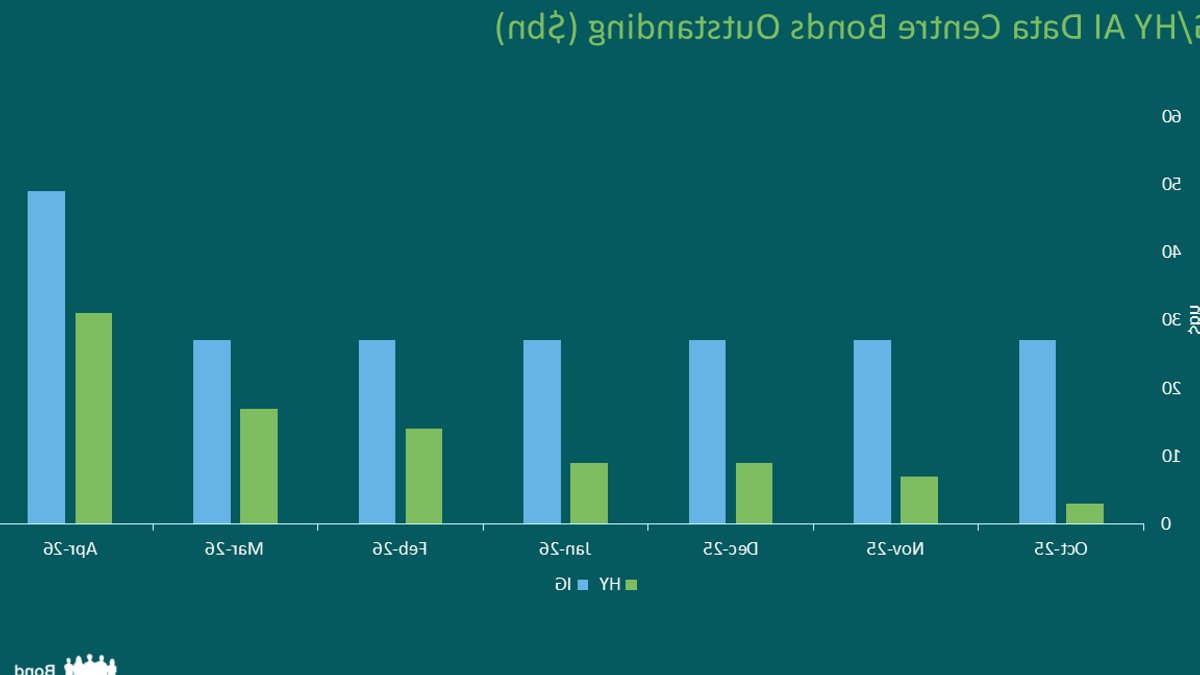
In under two years, debt issuance tied to AI—primarily for data centers—has grown from almost nothing to nearly $40 billion. Expectations are for total high yield, AI-related issuance to reach $100 billion to $120 billion over the next few years. Should this manifest, it would represent close to 4% to 5% of the global index and 6% to 7% of the U.S. index, of similar scale as long-standing and well-established retail and capital goods subsectors.
A new sector emerges
The growth is striking. Since early 2024, about $30 billion in AI-related high-yield bonds have entered the market. This accounts for 2.6% of the U.S. high-yield index and 1.6% of the global benchmark.
At least 15 high-yield data center bonds now trade, totaling $39 billion. CoreWeave, a neocloud provider, represents $6.5 billion of that amount. These bonds resemble project finance in some ways—typically five-year terms with amortizing structures—but differ significantly in risk. Some issuers have financial support from major tech companies like Google, while others operate without such backing. Some hold contracts with Nvidia or hyperscalers such as Amazon, Microsoft, and Meta, while others depend on smaller tenants. Some facilities are already running, while others remain in early development.
Energy supply presents another divide. A few projects have secured long-term power agreements, including backup sources. Others are still negotiating, leaving them vulnerable to price fluctuations or delays. Lease terms, cost overruns, and covenants add further complications.
Bubble warnings
Skeptics question whether the surge will last. They compare it to the telecom bubble of the early 2000s or the energy sector’s overinvestment between 2015 and 2017, when investor excitement outpaced reality. Concerns include potential overcapacity—what if AI compute demand doesn’t rise as quickly as expected? Or what if contracts with big tech tenants, unproven in a downturn, collapse?
Related: Bitcoin adviser Keiser guides El Salvador bonds
The global data center expansion alone may require $5 trillion to $7 trillion in investment by 2030, including 122 gigawatts of new power capacity. High-yield bonds represent just one part of this effort, but their role is expanding rapidly.
Fund managers face the task of weighing the potential against the risks. The sector’s size and yields make it difficult to ignore, but heavy bets assume current demand projections hold. Most agree the space is too new to dismiss entirely, though it remains too uncertain for uncritical acceptance.
For now, the market is still adjusting. Analysts and portfolio managers are working to grasp the details—how lease agreements function, what happens if energy costs spike, or how quickly tenants can switch providers. The terminology itself is evolving: words like “hyperscaler” and “neocloud” don’t appear in standard spell-check dictionaries.
The pace of change is remarkable.
This shift mirrors broader trends in market strategy under volatile conditions, where rapid adaptation becomes essential.

LME volatility tests Arxada’s market strategy


