


Korea stocks defy strong economic fundamentals
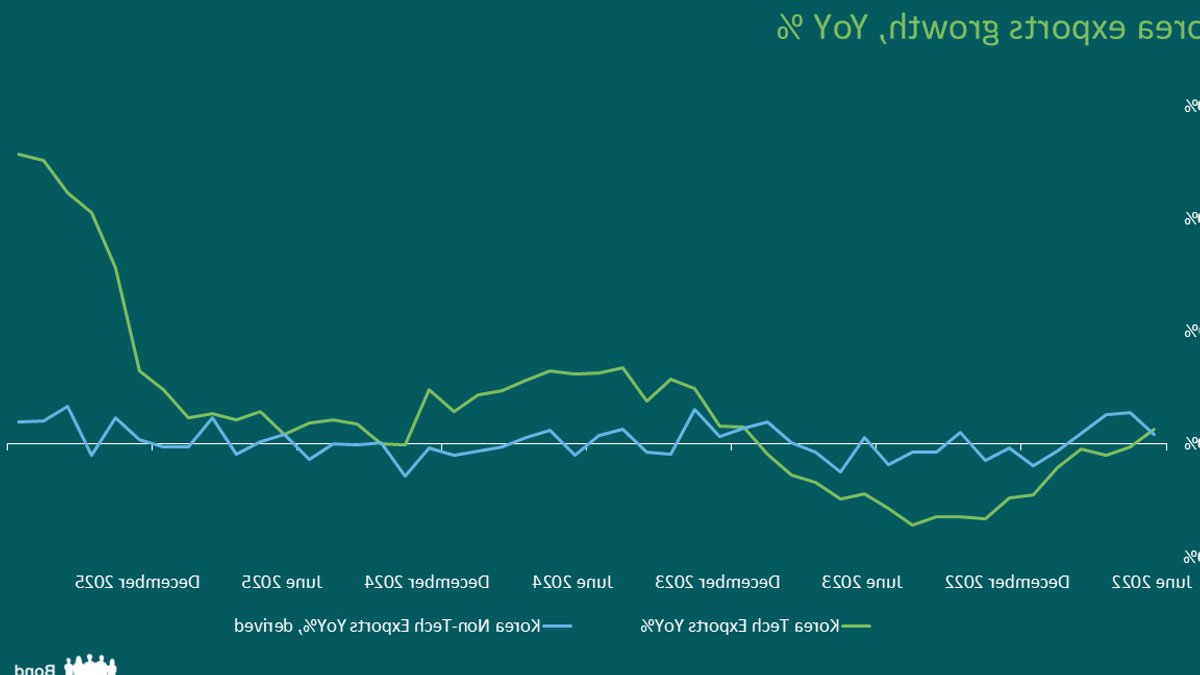
Korea’s strong fundamentals have not been reflected in its market pricing, with the Korean won and Korean Treasury Bonds being among the weakest performers globally. The country has emerged as one of the biggest beneficiaries of the global AI boom, with the KOSPI surging 262% since the start of 2025.
This equity rally has coincided with a stronger economic backdrop, driven by booming semiconductor exports. Korea’s current account surplus reached a record USD123 billion, or 6.5% of GDP in 2025, with another record surplus expected this year.
The strength of the semiconductor industry has more than offset weakness elsewhere, and rising household incomes and wealth effects are expected to lift GDP growth to around 2.7% in 2026. However, despite these supportive fundamentals, the KRW has remained one of the weakest currencies, depreciating 12.6% against the US dollar over the last twelve months.
The bond market has displayed a similar disconnect, with KTBs being the worst-performing local currency bond market in Asia since mid-2025. The iBoxx ALBI Korea Index has declined 10% in local currency terms since end-June 2025.
Capital flows have overwhelmed macro fundamentals, driving the divergence between fundamentals and market pricing. Equity-related outflows, overseas allocation by domestic investors, and limited conversion of export receipts back into won have all contributed to the weakness of the KRW.
Related: Drunken dragon tail stunt goes awry
Approximately USD100 billion has flowed out of Korean equities over the last 12 months, with the bulk of the outflows driven by Samsung Electronics and SK Hynix, which together account for half of the KOSPI’s market capitalisation. Other factors, such as exporters converting a relatively small proportion of their US dollar receipts into KRW, have also weighed on the won.
Net foreign direct investments have remained in negative territory, offsetting the positive impact of Korea’s record current account surplus and continued foreign demand for government bonds. The gap between market pricing and macro fundamentals has widened, and it is becoming increasingly difficult to justify the scale of the repricing.
It is possible that the market has become overly pessimistic on both the Korean won and Korean rates.
KTB inclusion in the FTSE World Government Bond Index may help to stabilize the bond market.
Excessively restrictive financial conditions could themselves become a source of financial instability. They may even undermine the economy’s growth prospects.
Related: Court orders seizure of Oxford Street hotel
For bond investors, the balance of risks is therefore beginning to look more asymmetric. Inflation and financial stability concerns still matter, but a significant amount of tightening risk is already reflected in KTB pricing. Investors should consider this when making investment decisions.
Markets have become overly pessimistic on both the Korean won and Korean rates. Accordingly, they have become more constructive on both KRW and KTB duration within their Asian local currency bond portfolios.
Nearer-term corporate flows may also prove supportive, with markets expecting a meaningful portion of proceeds from SK Hynix’s planned US ADR listing to be converted into KRW to finance domestic semiconductor investments. This could help to boost the won.
As capital flow pressures gradually moderate and Korea’s strong external position continues to assert itself, both the won and the domestic bond market should increasingly reprice towards stronger underlying fundamentals. The adjustment will likely be gradual.
Korea’s fundamentals and market pricing have moved too far apart. It is likely that the adjustment will not be immediate. However, as capital flow pressures moderate, they should begin to reflect Korea’s stronger underlying fundamentals more clearly.

Drunken dragon tail stunt goes awry


