


Rethinking emerging markets for a new era
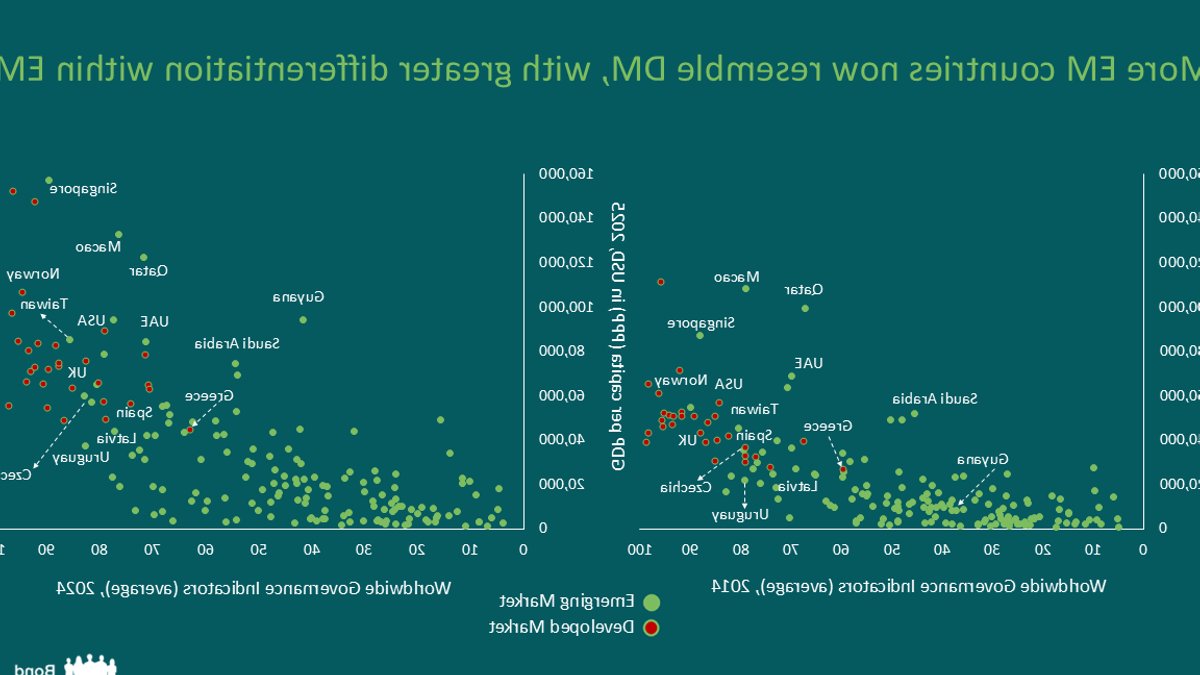
Emerging market bonds posted double-digit returns in 2024, outperforming developed market bonds and attracting crossover investors. The trend has renewed discussions about the definition of an emerging market and whether the traditional labels remain relevant.
Blurred lines between emerging and developed markets
The long-standing separation between emerging and developed markets is becoming less distinct. Policy uncertainty, once seen as a defining feature of emerging markets, now appears in developed economies as well. Examples include U.S. trade disputes, political interference with the Federal Reserve, and extended instability in France.
Meanwhile, many emerging market countries have strengthened their policy frameworks and institutions over the past ten years. This two-way convergence reduces the clarity of the distinction. The International Monetary Fund has expanded its list of “advanced” economies in recent years, with Croatia and Israel among the latest additions. Bulgaria may join in 2026 if it adopts the euro.
Related: US Infrastructure Boom Comes at High Cost
The IMF’s classification criteria—per capita income, export diversification, and financial integration—are not fixed. Its most recent World Economic Outlook includes 42 advanced economies, though the list changes over time. Markets, however, rely more on JP Morgan’s definitions, which differ significantly. Czechia, Croatia, Latvia, and Lithuania are still considered emerging by JP Morgan, despite the IMF’s advanced classification. Slovenia, with lower per capita income than Czechia, does not even appear in JP Morgan’s emerging market index.
Inconsistent benchmarks create confusion
JP Morgan’s widely used EMBI and CEMBI indices follow different rules. Qatar and Kuwait were removed from the EMBI due to high per capita income, but their corporate bonds remain in the CEMBI. Israel, South Korea, Singapore, Taiwan, Hong Kong, and Macao—all classified as advanced by the IMF—are included in the CEMBI through their corporate issuers.
These inconsistencies indicate the current system no longer fits modern realities. A better approach might combine per capita income with governance metrics. While income is easy to measure, governance is frequently ignored.
Related: Australia’s housing boom faces fresh pressure
The gap within emerging markets is widening. Some, like the UAE, combine high income with strong governance, while others lag in both. The term “emerging market” now covers too broad a range to be practical.
Investors may require a new system that aligns with current economic and institutional conditions. Until such a framework emerges, outdated classifications will continue to create confusion.

US Infrastructure Boom Comes at High Cost


